March 19th, 2025
When clean water is easy to find, every refill makes a difference.
Utilities
Workflow Design
IED Milan Scholarship Winner
Role
Product Designer
Timeline
2 weeks
team
Solo
platform
Mobile
The refill app helps you find nearby water refill stations, track your impact, and stay hydrated - while saving the planet.

The Real Problem
While traveling through Rome - a city famous for its free public drinking fountains - I couldn't find a reliable water source when I needed it. I'd search "water fountain near me," only to find outdated locations, dry fountains, or results that simply didn't exist. Like most tourists, I ended up buying a plastic bottle despite knowing free drinking water was probably just around the corner.
After speaking with some long-term travelers and backpackers friends of mine, I realized this wasn't unique to Rome. The same frustrations came up repeatedly: people knew water refill stations existed, but had no reliable way to find them or trust the information they saw.
The real problem wasn't access to drinking water - it was access to accurate information. Existing map services treat fountains as static points of interest, with little verification, no live status, and no community feedback. Without trustworthy data, people default to the one option they know will work: buying another plastic bottle.

Finding the Fix
After analyzing the problem, it became clear that the challenge wasn't discovering refill stations - it was trusting them. Three key issues came up:
No verification - Users couldn't tell whether a station was working, accessible, or even still there. Let alone the quality of the water.
No context - Fountains, cafés, and public taps were all treated as identical map pins, with little information to help users choose.
No way to keep information current - Static listings quickly became outdated without community involvement.
This led to three core design decisions:
Create a living map - Every refill station includes photos, descriptions, tags, ratings, and community reviews, giving users confidence before they make the walk.
Make contributions effortless - Adding or updating a station takes just a few taps, allowing the map to stay accurate through community participation.
Reward sustainable behavior - Partner businesses can offer small discounts when users refill instead of buying bottled water, creating value for both travelers and local businesses.
Rather than building new infrastructure, the solution focuses on making existing refill stations easy to discover, trust, and keep up to date.
A Commons Project
Refill is based in the understanding that water is a vital element of our heritage as humanity, and access to it should be considered a basic right. The app directly addresses the concept of water as a common by promoting the use of public water refill stations. These stations are framed as essential community-managed resources, and most importantly, shared by all. Refill empowers users to actively support this vision by enabling them to easily find, share information about, and maintain the shared knowledge of these resources, ensuring wider access to it, and while promoting a shift away from using one-time-use plastic water bottles.

How does it work?
Discover and navigate to nearby public water refill stations with an interactive map, and filters. Users are able to choose the best option based on detailed station information, including user ratings and the number of reviews.
Push users to make known choices by monitoring their daily hydration, visualizing the positive impact of reduced plastic use, and tracking the financial benefits of choosing to refill their water bottles.
Help the community by enabling users to add and verify refill station locations, contribute to the accuracy of information through reviews and ratings, and help others discover clean sources of water.
The Refill app works on the idea where users collectively maintain and improve the quality of water source information. Each contribution creates an effect of collective benefit - when you refill your bottle and add or rate a station, you're not just saving plastic, you're participating in a global commons movement. To ensure accuracy, our verification system relies on community feedback. The app also shows users how their individual refills add up to make a big difference for the environment.
The Impact
Environment – Less Plastic Pollution
By promoting the use of refill stations, the “Refill” app helps reduce reliance on single-use plastic bottles, directly cutting down plastic waste. This means fewer bottles in landfills, oceans, and streets - leading to a cleaner, healthier environment.
People – Access to Clean, Free Water
Travelers, backpackers, and everyday commuters are always on the lookout for fresh water refills. The “Refill” app ensures they can easily find nearby public fountains, reducing their need to buy bottled water. This not only saves money but also encourages a more sustainable way to stay hydrated.
Communities – Data for Better Coverage
Users contribute by adding and rating refill stations, ensuring accurate and up-to-date information for everyone. This crowdsourced approach strengthens communities, pushes collaboration, and expands access to free drinking water worldwide.

Design Tools & Inspiration
To bring this project from a thought to a product, I used Figma as my primary design tool, allowing me to create a clean, intuitive, and neat interface. For inspiration, I analyzed navigation and accessibility patterns from apps such as Google Maps and Apple Maps, as well as apps like Duolingo, which have stats-tracking and user engagement areas that could improve the app’s usability.
In addition, I also explored the community-based website Behance for UI/UX inspiration, studying how designers approach applications such as mine. For visuals, I used the Unsplash plugin inside of Figma to source high-quality images that fit perfectly with my vision for the app.
Research & User Insights
This project started from a personal experience. Over the past year or two, I’ve had the opportunity to travel all over the world - from major cities in Europe to unexpected places in the U.S. But if there’s one challenge I’ve consistently faced, it’s finding free, accessible water refill stations when I need them most. Take Rome, for example - a very touristy city with plenty of free, drinkable water fountains. Yet, despite their availability, they can be surprisingly hard to find when you need them. This led me to wonder: why isn’t there an easier way to locate public water sources on the go?
To gain a better perspective, I spoke with friends who have spent 6+ months backpacking, gathering insights into the real challenges travelers face when trying to stay hydrated while traveling.
Beyond those accounts, I conducted a research into existing apps with similar goals, analyzing their functionality, user experience, and effectiveness. I also explored global statistics on plastic bottle consumption and waste, strengthening the main thought behind this app, which is creating a solution that encourages refill culture and reduces plastic pollution.
I sent out a survey to 10 key participants and conducted semi-structured user interviews with 4 participants.
"HALF THE PINS ARE GHOSTS"
Google Maps often showed fountains that were dry, moved, or never there to begin with. After enough dead ends, she stopped trusting map pins entirely and started asking locals instead - meaning most travelers never find the water that's actually available.
"IS THIS WATER EVEN SAFE?"
In unfamiliar cities she had no way to tell if a tap was drinkable or not, so she avoided public fountains entirely unless a local vouched for it first.
"I'D RATHER JUST BUY ONE"
Even when a fountain might be nearby, the risk of walking over and finding it broken wasn't worth it. He'd default to buying a bottle "just to be safe," because convenience always beats an unreliable free option.
"WHY AM I THE ONLY ONE UPDATING THIS?"
He noticed listings never improved over time — someone would add a spot once, then nobody had a reason to maintain it. Stale information just piled up with no one responsible for fixing it.
The Main Screens
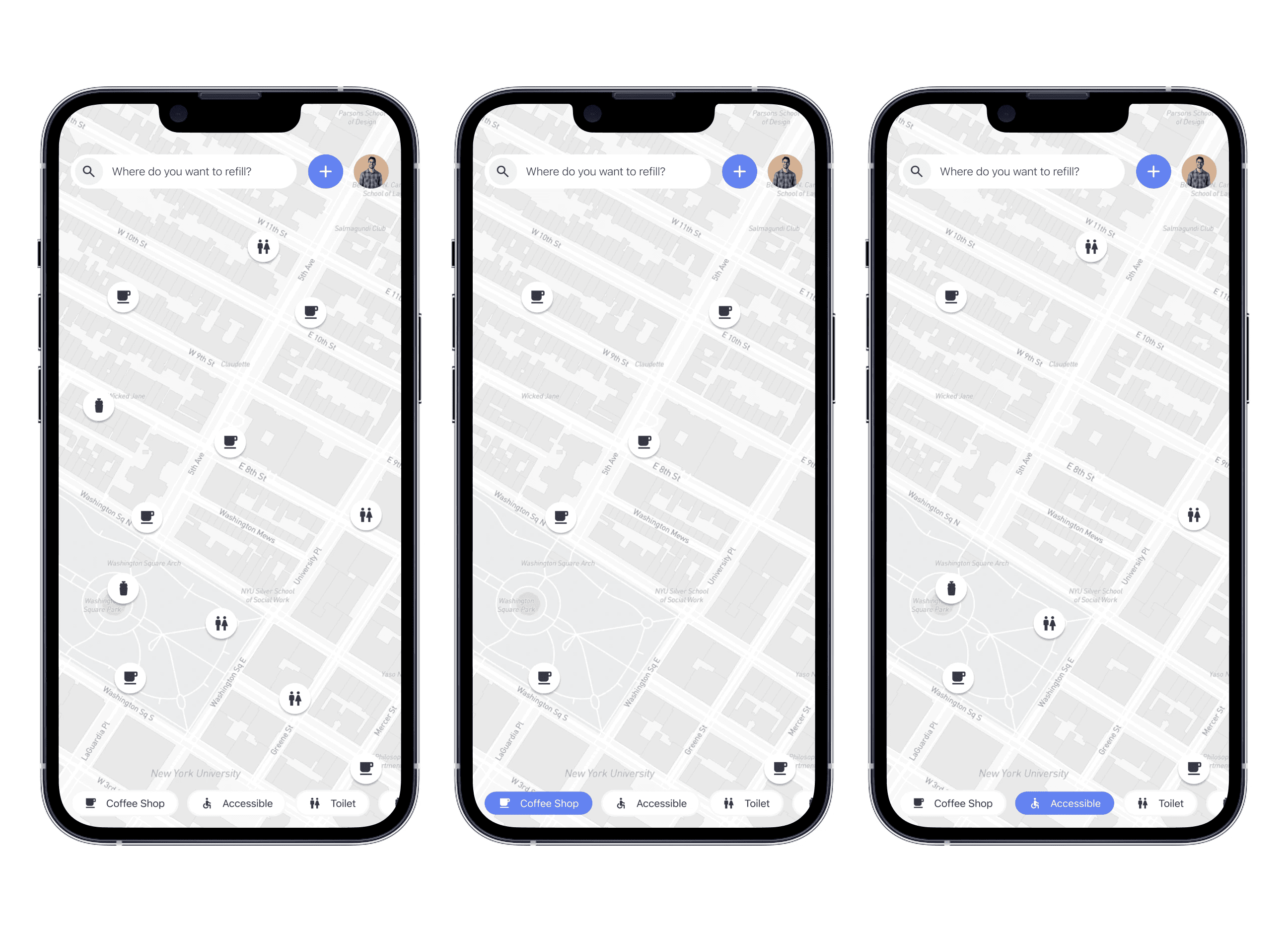
The app's main screen is an interactive map displaying all nearby refill stations, whether they are public fountains, cafés, or other locations offering free water refills. Users can filter locations based on their needs, such as only fountains, places with wheelchair access, or public restrooms. In addition, there is a search bar that allows users to find specific streets or places according to their needs.
The Stations
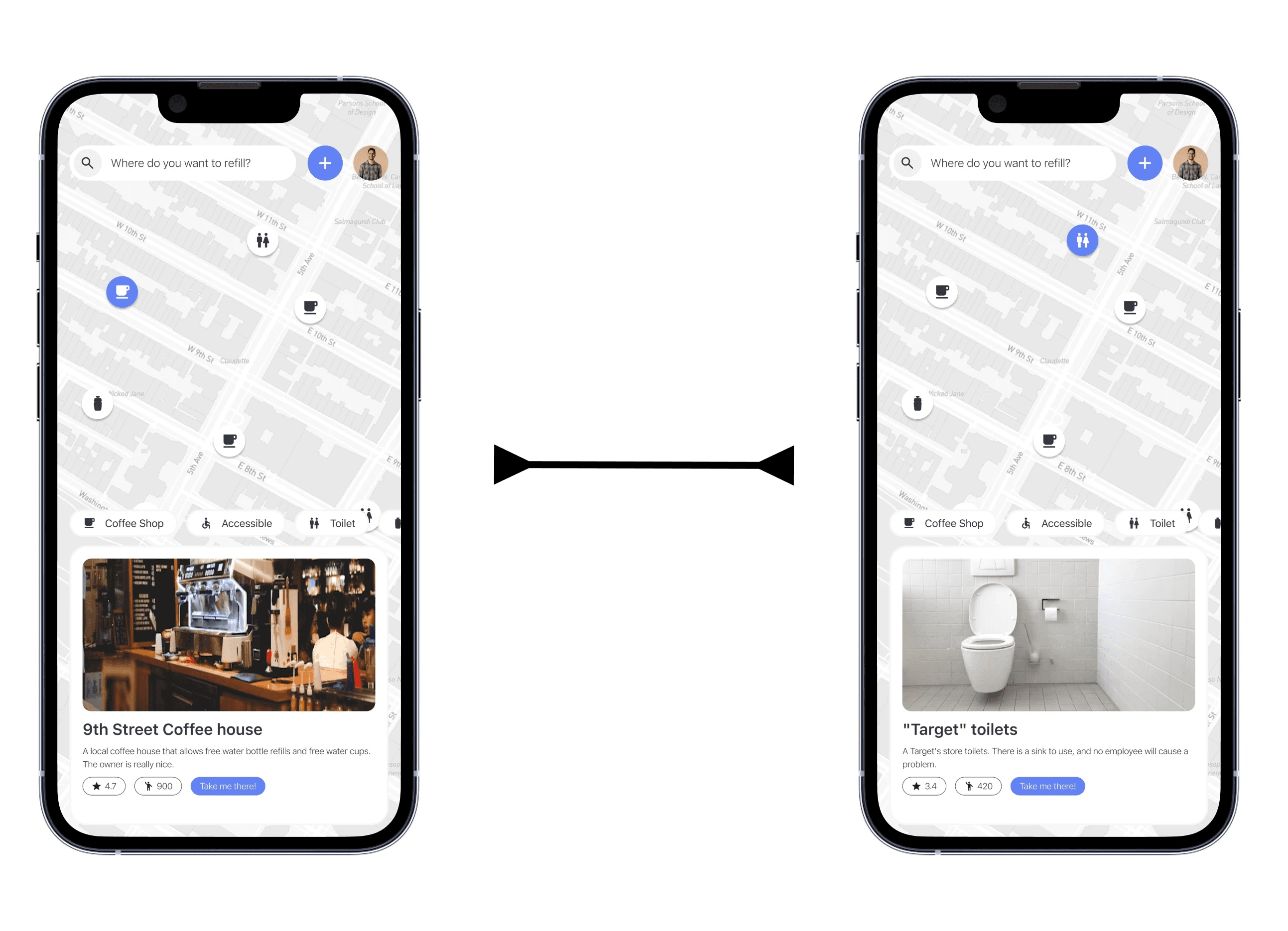
When users tap on a specific refill station, a pop-up window appears with essential details about the location. This includes a photo of the spot, a title and brief description to help users understand what to expect, and a rating system where users can see the average rating out of 5 stars, along with the total number of reviews. This feature allows travelers to make informed decisions about where to refill based on real user feedback.
Settings & Offline Page
In the Settings page, users can manage their privacy settings, account details, and general preferences to personalize their experience. Additionally, they can access the Offline Maps section, allowing them to download maps for specific areas. This ensures they can still find refill stations even when traveling in areas with limited or no internet connection, making the app a reliable tool for all users, including backpackers and frequent travelers.

The future is filled with opportunities
Custom Widgets & Notifications
Future updates could introduce custom widgets and smart notifications. Features like refill reminders based on location or time of day would make sure users never forget to stay hydrated. A pop-up prompt could encourage users to rate the quality of their latest refill, improving the accuracy of community data. Additionally, a daily streak counter tracking the number of days a user has avoided purchasing plastic bottles would create a sense of accomplishment and motivation for long-term environmental impact.
Reward System
To encourage active participation, a reward system could be integrated, allowing users to earn points for refilling their bottles, adding new refill spots and contributing reviews. Over time, these points could be redeemed for discounts on the app’s merchandise, exclusive app perks, or even free eco-friendly products. This system would push users to engage more with the app while reinforcing sustainable behavior in a fun and rewarding way.
Local Governments & City Halls
Collaboration with local governments and city halls could greatly expand the app’s database by gaining access to official refill station data that may not yet be publicly available. Cities committed to reducing plastic waste could integrate their infrastructure into the app, ensuring better coverage and reliability for both locals and tourists. Additionally, such partnerships could lead to government-backed sustainability initiatives, increasing public awareness and encouraging more establishments to provide free refill stations as a standard practice.
The change